The right floor in a commercial or industrial building is not just a surface people walk on. It directly affects safety, durability, maintenance costs, workflow efficiency, noise levels, and even employee fatigue.
A warehouse floor handles forklifts and pallet jacks. A hospital floor must resist bacteria and constant disinfection.
A retail store floor needs to look good while surviving heavy foot traffic.
There is no universal “best” floor.
Every building type requires a specific solution tailored to load, moisture, chemicals, temperature shifts, and daily wear.
Poor choices lead to cracking, surface failure, safety hazards, and expensive repairs.
Choosing correctly can mean decades of service with minimal downtime.
Below is a full breakdown of the most commonly used commercial and industrial flooring types, what they are actually good for, and where problems appear in real-world use.
Polished Concrete Flooring
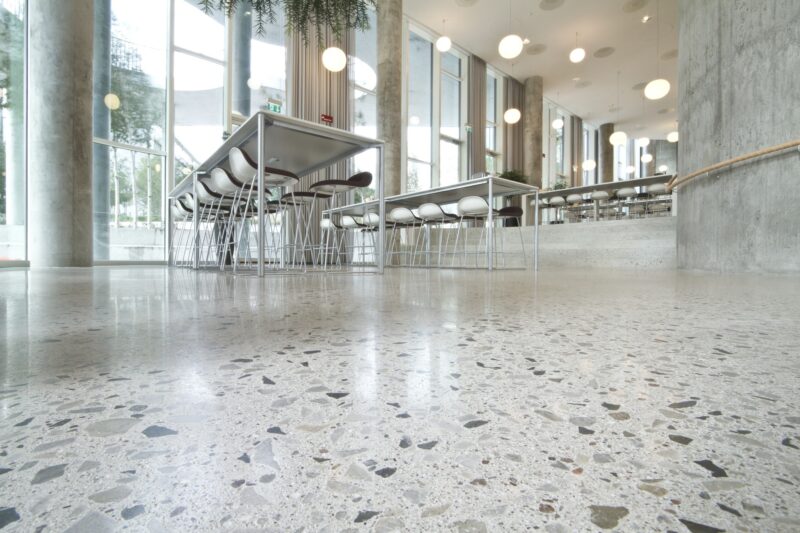
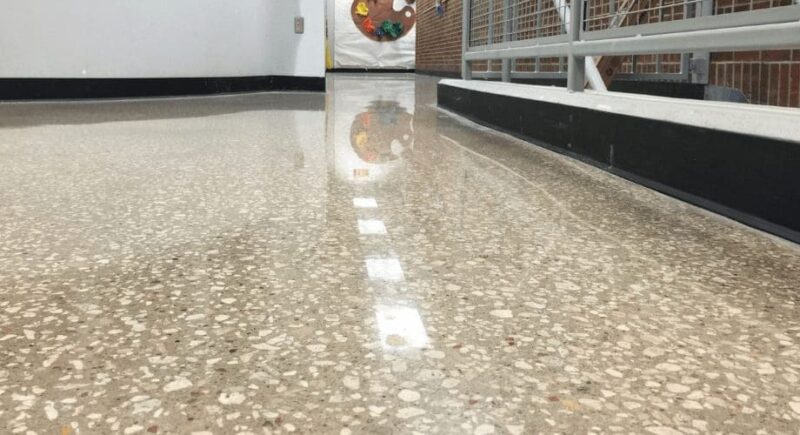
Polished concrete is one of the most widely used floors in both commercial and industrial buildings.
It starts as standard concrete that is mechanically ground, sealed, and polished to achieve a smooth, reflective finish.
This flooring performs exceptionally well under heavy loads. Forklifts, pallet racks, and industrial carts can operate on polished concrete without surface failure when the slab is properly poured and cured.
The surface resists abrasion better than most coatings and does not peel or delaminate.
Maintenance is straightforward.
Regular dust mopping and periodic burnishing are usually enough to keep it clean.
From a commercial standpoint, polished concrete is popular in retail stores, showrooms, grocery stores, airports, and office lobbies.
The reflective surface improves lighting efficiency and reduces energy consumption. In industrial buildings, it is used in warehouses, logistics hubs, and production halls.
Drawbacks exist. The surface can become slippery when wet if not treated with proper slip additives.
Concrete is also unforgiving underfoot. Long shifts on concrete contribute to joint fatigue and lower-back strain unless anti-fatigue mats are installed in standing work areas.
Epoxy Resin Flooring
Epoxy flooring is a two-part resin system applied as a coating over concrete. Once cured, it forms a dense, seamless, and chemically resistant surface.
This type of floor is chosen where hygiene, chemical protection, and moisture resistance are critical.
Food processing plants, pharmaceutical facilities, laboratories, car workshops, and hospitals all rely heavily on epoxy systems.
Epoxy does not absorb liquids, which makes it ideal for environments exposed to oils, acids, blood, disinfectants, and solvents.
Epoxy floors also allow for color coding. Walkways, safety zones, forklift paths, and restricted areas can all be marked directly into the floor system instead of being painted afterward. This improves long-term visibility and safety.
However, epoxy requires careful installation. Surface preparation is everything. If moisture migrates upward from the concrete slab, bubbling and delamination occur.
Repairs are visible and usually require re-coating entire sections.
Over time, UV exposure can cause yellowing in sun-exposed areas unless UV-stable topcoats are used.
Vinyl Flooring for Commercial Spaces
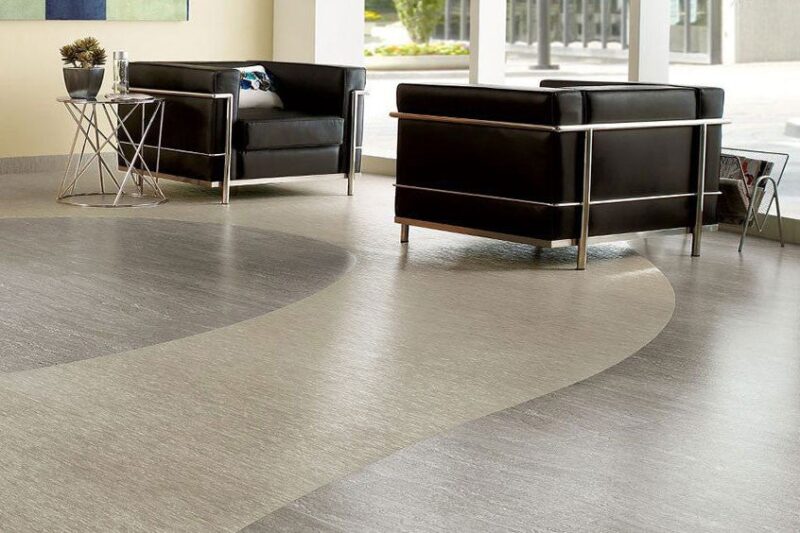
Vinyl flooring shows up in offices, schools, healthcare buildings, hotels, and retail chains. It comes in sheets, planks, or tiles and is designed to mimic wood, stone, or ceramic while offering better durability and moisture resistance.
One major reason vinyl dominates commercial interiors is comfort. It is softer than concrete or ceramic, which reduces fatigue for staff who stand all day.
It also absorbs sound far better than hard surfaces, making it excellent for offices, call centers, classrooms, and hotel corridors.
Modern commercial-grade vinyl resists scratches, dents, stains, and disinfectants. It is also easy to repair since damaged tiles or planks can be replaced individually.
Its limitation is load capacity. Heavy machinery, industrial shelving, and rolling loads can indent or tear vinyl.
That is why it remains mostly a commercial interior solution rather than a true industrial work surface.
Ceramic and Porcelain Tile Flooring
Tile flooring remains dominant in retail bathrooms, food service areas, kitchens, laundry rooms, and medical washing zones. Porcelain tiles, in particular, handle water, heat, grease, and constant cleaning far better than most alternatives.
They are non-porous, easy to disinfect, and highly resistant to chemicals. In restaurants and food prep areas, tile floors paired with proper drainage help meet sanitation regulations.
The biggest problem with tile is impact resistance. Dropped tools, heavy stock carts, or point loads can crack individual tiles. Grout lines also require maintenance. Poor sealing allows moisture infiltration and bacterial growth in wet environments.
Rubber Flooring for Commercial Safety Zones
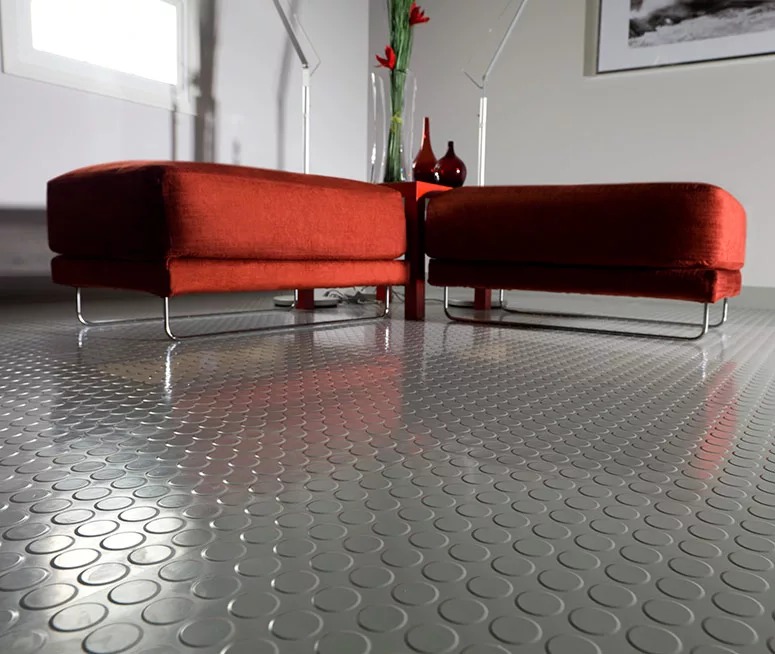
Rubber flooring is common in gyms, healthcare facilities, rehab centers, schools, and industrial safety walk zones. It offers shock absorption, sound dampening, and excellent slip resistance.
In manufacturing plants, rubber mats protect workers standing at assembly stations for long hours. In commercial fitness centers, thick rubber absorbs dropped weights without damaging subfloors.
Rubber handles moisture well but reacts poorly to oils, petroleum products, and certain chemicals. In automotive workshops or fuel handling facilities, rubber flooring degrades quickly and is not recommended.
Industrial PVC and Interlocking Tile Floors
Interlocking PVC floor tiles are widely used in workshops, garages, warehouses, and temporary production spaces.
These are thick, modular tiles that lock together without adhesives.
Their biggest strength is flexibility. Floors can be installed quickly without shutting down entire operations. Individual damaged tiles are replaced in minutes.
The tiles absorb vibration from machines and protect the concrete slab underneath.
These systems also work well in mezzanine structures, where weight distribution and vibration control matter.
In facilities that feature elevated working platforms, storage decks, or multi-level layouts, load-rated interlocking tiles often pair with steel platforms and integrated systems, such as types of mezzanine floors, to create durable upper-level work zones without overloading structural components.
The downside is long-term durability under extreme heat or chemical exposure.
PVC tiles can soften under high temperatures and swell if constantly flooded.
Natural Stone Flooring for High-End Commercial Use
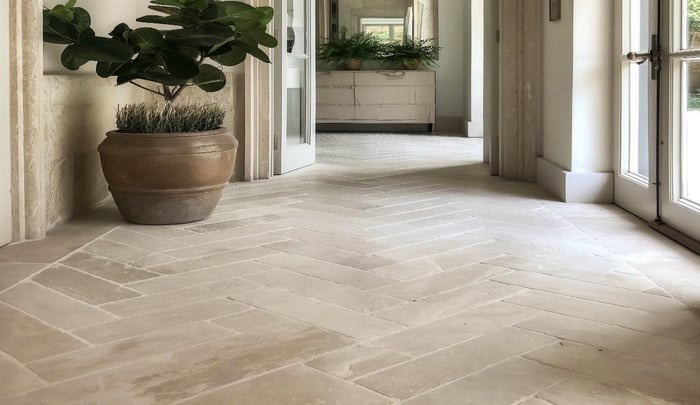
Granite, marble, limestone, and slate floors appear mostly in luxury commercial spaces. Hotels, office towers, government buildings, and high-end retail environments use stone floors for visual prestige.
Stone offers enormous compressive strength and long service life when properly maintained.
Granite, especially, resists wear very well. Marble and limestone are softer and more prone to scratching and acid etching.
Maintenance is intensive. Regular sealing, polishing, and stain management are required. Stone floors are rarely used in industrial settings due to their fragility under mechanical loads.
Hardwood and Engineered Wood Floors
Wood flooring in commercial buildings is limited to retail boutiques, hospitality areas, offices, and cultural venues.
It provides warmth and acoustic comfort that no synthetic surface can fully replicate.
Engineered wood dominates over solid hardwood in commercial construction due to better dimensional stability. These systems tolerate humidity swings better and can be refinished multiple times during their lifespan.
From an industrial perspective, wood has limited use. It cannot carry heavy rolling loads, resists chemicals poorly, and degrades under water exposure.
Metal Flooring Systems in Industrial Environments
Metal floors, including steel plate flooring, tread plate, and aluminum decking, serve specific industrial roles.
They are used on catwalks, machine platforms, mezzanines, offshore facilities, and maintenance access routes.
Steel floors handle extreme point loads, firefighting environments, chemical washdowns, and high temperatures. They pair well with structural steel frames and are common in power plants, refineries, and heavy manufacturing halls.
They are noisy under foot traffic and require corrosion protection if moisture is present. Proper corrosion and anti-slip coatings are mandatory due to smooth metal surfaces becoming dangerous when wet.
Comparison Table of Major Flooring Types
| Flooring Type | Best For | Load Capacity | Chemical Resistance | Comfort | Maintenance |
| Polished Concrete | Warehouses, Retail | Very High | Moderate | Low | Low |
| Epoxy Resin | Food, Medical, Labs | High | Very High | Medium | Medium |
| Vinyl | Offices, Schools | Low to Medium | Moderate | High | Low |
| Tile | Kitchens, Bathrooms | Medium | High | Low | Medium |
| Rubber | Gyms, Safety Zones | Medium | Low to Medium | Very High | Low |
| Interlocking PVC | Workshops, Garages | High | Medium | Medium | Very Low |
| Natural Stone | Luxury Retail | High | Low to Medium | Medium | High |
| Wood | Offices, Hotels | Low to Medium | Low | High | High |
| Metal | Platforms, Industrial Access | Extreme | Very High | Very Low | Medium |
How to Choose the Right Floor for Your Building
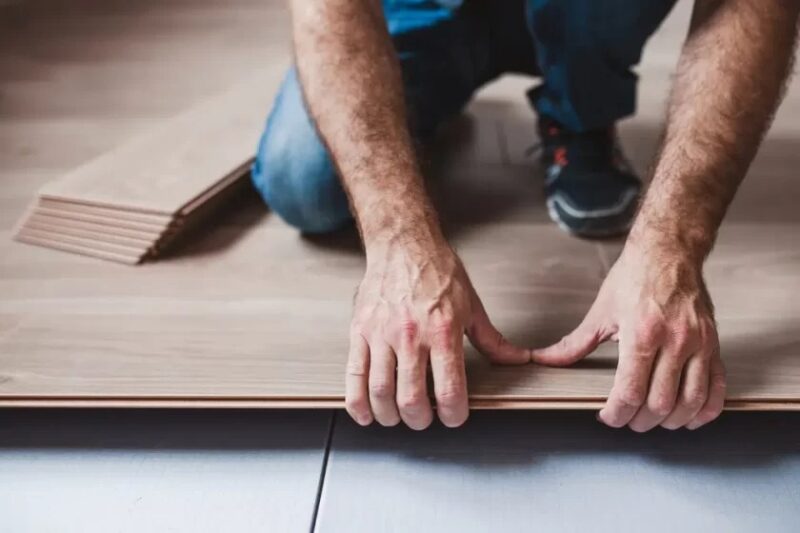
The wrong floor fails quickly and costs more long-term than the cheapest upfront option. The correct choice always begins with real usage analysis.
Load ratings matter more than appearance in industrial buildings. Chemical exposure matters more than comfort in laboratories. Slip resistance outweighs beauty in wet environments.
Commercial spaces have different priorities. Acoustics, aesthetic appeal, and ease of cleaning dominate decision-making. Employee comfort also plays a growing role as companies focus on long-term workforce health.
The most expensive flooring disasters usually happen when commercial materials are pushed into industrial roles.
Vinyl warehouses, thin tiles under heavy racks, and decorative concrete under forklifts all fail under real load.
Final Reality Check
There is no universal commercial or industrial flooring solution. Each material solves specific problems and creates new ones.
Polished concrete wins on durability. Epoxy wins on hygiene. Vinyl wins on comfort. Rubber wins on safety. Steel wins on extreme load.
The only correct decision comes from matching the actual work environment to the physical limits of the floor system itself.
When builders and owners focus on performance first and look second, floors last decades instead of years.