
A foreigner can walk into a notary’s office on the Montenegrin coast and leave as the registered owner of a seaside apartment. The same person cannot hold freehold title to a single square metre of land in Thailand, however much money they bring. Buying property abroad as a non-resident works like that everywhere: the rules depend on the country, the type of property and your passport.
Before you sign anything, three questions need a clear yes. Are you legally allowed to own this kind of property? Does the seller hold clean, registered title? Do you know the full tax bill and what ownership gives you, and what it doesn’t? Get those answers in writing and most horror stories never begin. Skip them and a holiday dream can turn into years of paperwork in a language you don’t speak.
Key Takeaways
- Check first whether non-residents may own the specific property type, because land, apartments and holiday homes often follow different rules.
- Montenegro lets foreigners buy apartments and houses in their own name, with limits on agricultural land, forests and border areas.
- Canada, Australia, Switzerland and Thailand impose some of the toughest restrictions on foreign residential buyers.
- Spain and the United States attract the largest volume of foreign buyers, with Florida and the Spanish coast leading demand.
- Always verify title, debts and building permits in the official land registry before any deposit leaves your account.
- Property ownership and residency are separate legal questions, so never assume a purchase comes with a right to stay.
Buying Property Abroad as a Non-Resident Starts With Legal Eligibility
The first check has nothing to do with views or square metres. It concerns whether the law of that country lets someone with your citizenship and residence status hold title at all. Countries fall roughly into three groups: open markets, markets with quotas or permits, and markets where foreigners simply cannot own certain assets.
Where foreigners buy with few restrictions
Montenegro sits near the top of the open list. Apartments, houses and commercial premises are available to foreigners on terms close to those for locals, which partly explains why Budva, Kotor and Tivat fill up with German, Turkish, Serbian and Ukrainian voices every summer.
Spain is open as well, and enormously popular. According to the Spanish Property Registrars’ annual statistics, foreign citizens made 14.6% of all home purchases in 2024, close to the record set a year earlier.
The United States has no federal ban on foreign ownership either, which is why Florida condos are routinely sold to buyers who live in Toronto or Mexico City.
Other places that combine open rules with relatively affordable coastal or city property include Bulgaria (for buildings, with land usually bought through a local company), Greece, Portugal’s interior regions and Turkey.
Where the door is half closed, or locked
At the other end of the scale, the restrictions get creative.
- Thailand: Foreigners generally cannot own land. They can own condominium units, but the Thai Condominium Act caps foreign ownership at 49% of a building’s total unit area, and purchase funds must come from abroad.
- Philippines: The 1987 Constitution reserves private land for Filipino citizens and companies majority-owned by them.
- Switzerland: Under the Lex Koller rules, holiday homes for non-residents are rationed through cantonal quotas, and J.P. Morgan Private Bank notes that only 1,500 such authorisations may be issued nationwide each year.
- Canada: Non-Canadians have been barred from buying most residential property in urban areas since 2023, and Canadian Mortgage Professional reports the ban runs until 1 January 2027, with the government signalling it may not simply extend it again.
- Australia: The Australian Taxation Office enforces a ban on foreign purchases of established homes from 1 April 2025 to 31 March 2027.
Mexico deserves an honourable mention. Foreigners can own beachfront homes there, but only through a bank trust (fideicomiso) inside the constitutional “restricted zone” along coasts and borders.
The table below sums up the contrast.
| Country | What non-residents can usually buy | Main legal catch |
| Montenegro | Apartments, houses, commercial property, building land | No agricultural land, forests or border-zone property in a personal name |
| Spain | Almost any residential property | Foreign tax ID required; strict checks on illegal builds in rural areas |
| United States | Any residential property | Withholding tax on sale and estate tax exposure for non-residents |
| Thailand | Condo units within the 49% foreign quota | No freehold land ownership |
| Switzerland | Primary home only after moving there; holiday homes by permit | Annual cantonal quotas, some cantons allow none |
| Canada | Property outside major urban areas | Urban residential ban in force until 2027 |
Montenegro: An Open Market With a Few Locked Rooms
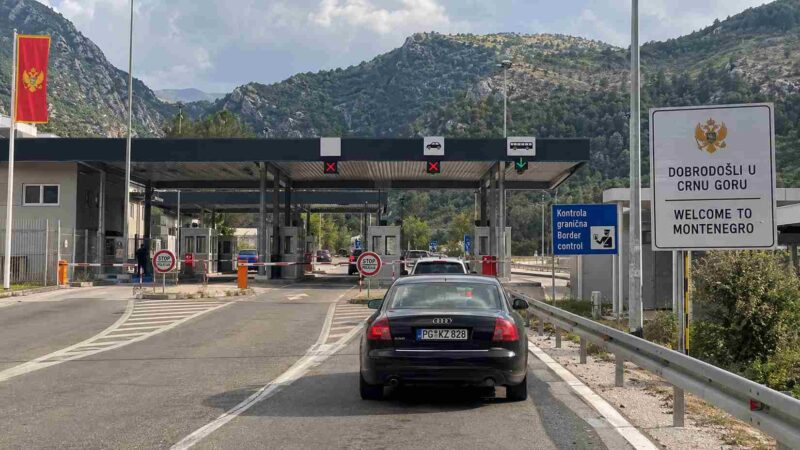
Montenegro is one of the friendliest countries in Europe for foreign buyers, yet “friendly” still comes with fine print. Knowing the fine print in advance is what separates a smooth purchase from a stalled one.
A guide published by CEE Legal Matters lists the main exclusions for foreign persons: agricultural land, forests and forest land, property within one kilometre of the land border, and islands. A pretty olive grove near Bar can therefore be off-limits even when the stone house next to it is perfectly purchasable.
Many investors solve that by buying through a locally registered company, which counts as a domestic legal entity. The Montenegrin Tax Administration publishes a step-by-step company registration guide, and buyers who prefer local support often look at Vega Plus company setup in Montenegro to handle incorporation, tax registration and bank coordination before the purchase itself.
A company route also makes sense if the property is a rental business rather than a family holiday base.
How the purchase becomes legally yours
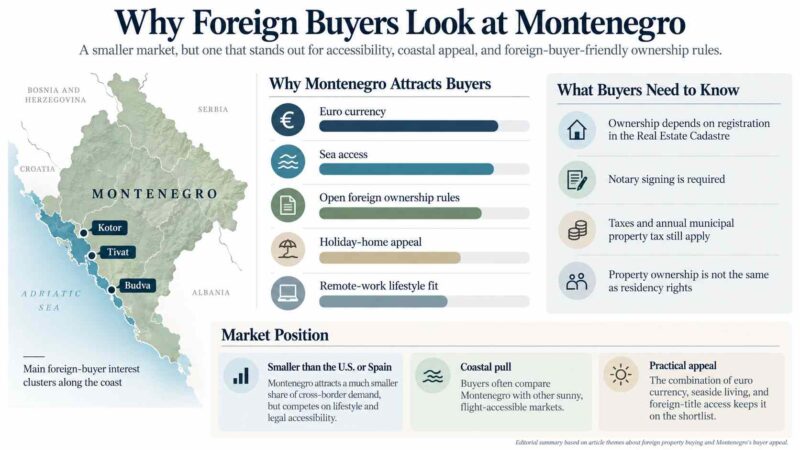
In Montenegro a sale contract for real estate must be signed before a notary, and ownership passes only when the buyer is registered in the Real Estate Cadastre. Handing over the keys does not transfer ownership. Before the notary appointment, check the property folio (list nepokretnosti) for mortgages, court notes, co-owners and the exact registered surface.
Taxes follow a progressive scale. On resale property, the real estate transfer tax is 3% on a tax base up to €150,000, then 5% on the portion up to €500,000, and 6% above that. Owners also pay annual property tax to the municipality.
Property is not a residence permit
Since 17 January 2026, the amended Law on Foreigners in the Official Gazette of Montenegro requires non-EU applicants seeking temporary residence through property to show real estate valued at €150,000 or more, based on the tax authority’s transfer tax decision.
A smaller studio is still a perfectly legal purchase; it just won’t carry a residence permit with it. Anyone weighing long-term real estate profitability should factor that distinction in early.
Where Foreign Buyers Actually Spend Their Money
Two markets dominate cross-border home buying by sheer volume, and the numbers say a lot about how people choose.
The National Association of Realtors’ 2026 report shows foreign buyers purchased $45.3 billion of existing US homes between April 2025 and March 2026, the second-lowest unit count since tracking began in 2009. Florida took 20% of those buyers, Canadians and Mexicans led by origin, and 48% paid all cash. That last figure matters: non-residents often struggle to get local mortgages, so cash is the default rather than a flex.
Spain is the European heavyweight. The Local Spain reported that foreigners made 13.58% of home purchases between January and September 2025, with Valencia leading foreign demand.
The pattern repeats wherever sunshine, direct flights and remote work overlap, which is also why so many buyers first discover a market while scouting cities where you can mix business and vacation.
Montenegro is far smaller in volume, but its pull is similar: euro currency, sea access and a legal system open to foreign title.
The Legal Checks to Make Before You Sign a Foreign Purchase Contract

Every country has its own paperwork, yet the checks that protect a buyer look remarkably similar from Lisbon to Pattaya. The UK government’s guidance for buying property abroad puts independent legal advice and verified title at the top of its list, and that advice travels well beyond British buyers.
Title, debts and co-owners
Pull the official land registry extract yourself, or through a lawyer who works only for you. Confirm that the seller’s name matches, that no mortgage or seizure note is registered and that every co-owner, including heirs, will sign. Inherited Balkan houses with eleven cousins on the deed are a classic trap.
Permits and the building itself
A registered flat can still sit on top of an unpermitted extra floor. Ask for the building permit and the use permit, and compare the surface on paper with the surface you walked through. In off-plan purchases, check that the developer owns the land and holds a valid permit before paying anything.
The money trail
Banks and notaries will ask where the purchase funds come from, and some countries have hard rules. Thailand, for instance, requires condo funds to arrive from abroad in foreign currency. Keep transfer records, and plan the currency exchange and fees as part of managing cash flow for the whole project, since one bad exchange day can wipe out a negotiated discount.
A short checklist before any deposit:
- Registry extract dated within the last few days
- Seller’s identity and power of attorney, if someone signs on their behalf
- Building and use permits matching the actual property
- Written confirmation of all taxes, notary fees and agency commissions
- A sworn translation of the contract if you don’t read the local language
Taxes after the purchase
Ownership creates obligations in two places: where the property sits and where you live. Rental income, capital gains and inheritance can be taxed by both, depending on treaties. Building those costs into a step-by-step financial plan before you buy keeps a good investment from becoming an expensive hobby. A local will is also worth considering, since inheritance law abroad can differ sharply from home.
FAQ

Hey, I’m Derek Vaughn. I love exploring how tech, business, and productivity come together to shape the way we work. At PulseBlueprint, I write about tools, trends, and strategies that actually make a difference—no fluff, just real-world insights.